This is a Heading Example
Let’s face it: they keep us captured. The big tech companies, with their flow of seemingly needed products and services, all tying us up on subscriptions and the impossibility of ever leaving them.
And who are they? Commonly spoken of as a bunch of American companies within the technological space that also happen to be the biggest companies in the world: Microsoft, Apple, Google/Alphabet, Amazon, Facebook/Meta, but with several additional companies behaving the same way and making the same kinds of problems for you, such as Nvidia, Tesla, Oracle, and Netflix, plus some Chinese companies as well: Baidu, Alibaba, Tencent, and Xiaomi1.
Effectively, there are many more, so maybe we could speak about “big and medium tech”, because it’s all about not being small anymore: the size makes them behave in such a way that leaves you, the ordinary consumer, in the shadow, and the mass production and profit from their services in the light.
Next to the tech-oriented companies, there are other sectors that in a similar way tend to dominate your life and deprive you of having real options when shopping or living. Wikipedia mentions Big Oil, Big Soda, and Big Tobacco, but I would consider Big Food to be just as problematic and dominant.
I think you get the picture. Big companies are bad for you, because they don’t care about you and your needs. Small companies will not survive without caring about you, because you’ll then simply stop buying from them. But the big ones tend to buy competitors and buy and close alternatives, so that you are left without options.
I would include some utility companies as well. We have, in some countries, a supposedly free choice of electricity provider, for instance, but due to the nature of electricity, some cables are needed for transporting it to us, and those cables are now owned by a few large operators who charge more and more for that service, and who you can’t replace. They have a monopoly on delivering electricity in your area, to your house.
So, as the main problem with these companies being big is that you then have no options, no other companies to go to, you can easily feel that you can’t do anything about it.
But that’s wrong.
Most of these big companies didn’t even exist just a few years ago, and at that time, we all lived happily without them. Of course, the world changes, and some of the big companies of today were once pioneers seeing a future where something new would be popular, so they entered early, did a solid effort, and became the big player in the field. Or so it seems.
Because, there has been others seeing the same light, doing a similar effort, but who just folded or gave up along the way. The difference lies in the access to investor money. If you have enough money, you can buy your way to world dominance, and some companies had that.
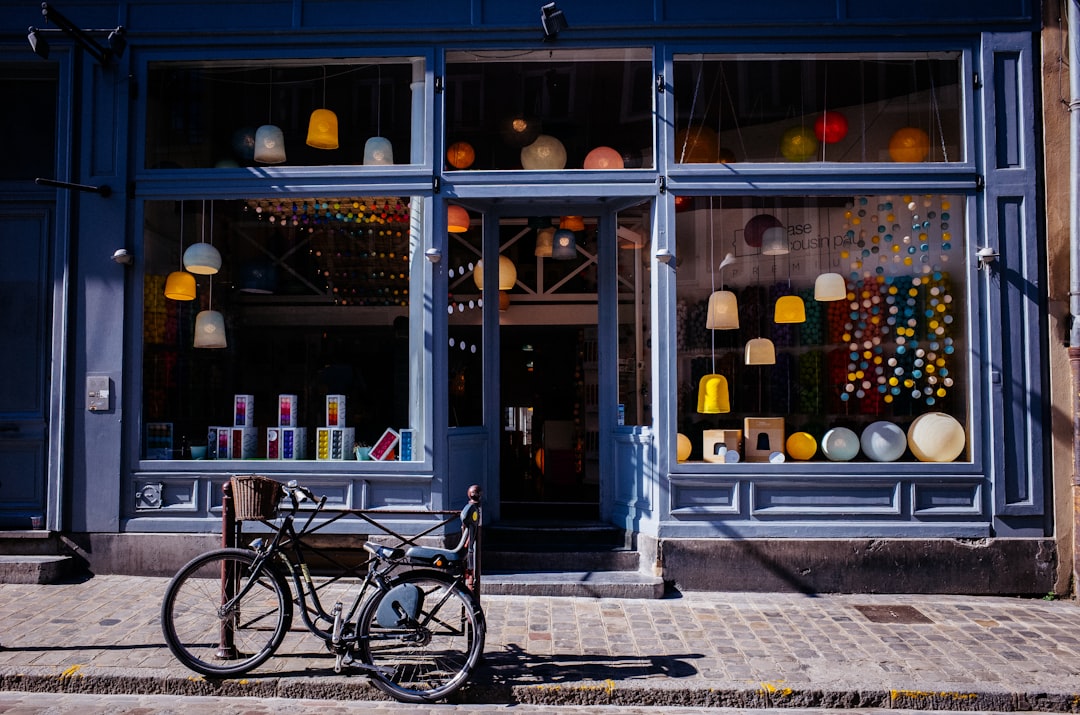
For this article, I chose a picture of a small lighting shop. The lighting industry was built during the last approx. 200 years – first with various forms of oil lamps (and spirits lamps in France), and later, with the invention of the electrical light bulb, making lamps mainly based on electricity.
In some countries, like the USA, this developed into very big electricity corporations, such as Westinghouse, that produced everything that had to do with lighting, such as the lamps themselves, light bulbs, cables, power plants, and the whole infrastructure for distributing the electricity.
But in other countries, a flood of small lighting manufacturers appeared, often based on one person and his ambitions. Kind of the first step further from a craftsman’s workshop. These companies then often lived for the time until that person retired, but just as often they closed before that, due to the competition.
Lamp shops would sell a variety of different brands from different vendors, and the selection would vary all the time, depending on availability and the ever-changing fashion, which very much counted for lamps, just as for many other manufactured items.
Today, all manufacturers, due to the competition, have sent the production to China, after a round of desperate mergers and consolidations, which has led to many local brands not producing anything at all, just reselling what the Chinese manufacturers have in their catalogue.
There are still some lights on in some of the many lighting businesses we used to have, but most of them have closed, along with the big nets of shops that by themselves have decided to send a procurist2 to China to pick some models that they can sell in their shops.
That’s another kind of “big” to be aware of – the absence of small companies, even if the resulting product availability isn’t branded specifically. The Chinese manufacturers may, at times, be very large companies, but often we speak about a part of a city, or a whole city, producing a certain group of products, so the individual manufacturing company isn’t necessarily big. However, the result is the same for you: you are left without options, because you can’t find the variety in the shops that you otherwise could have found, if only there were more companies working with designing and producing their own models.
Social media, of course, has now been monopolized. When I went through a Social Media Manager education some years ago, we could look at an overview of existing social media platforms, and there were many! I remember it as around 150, mentioned and systemized on one of the charts that were available then. But it was incomplete, as it stated itself, since new platforms appeared every day.
Since then, Social Media has effectively become Facebook, Instagram, LinkedIn, and Twitter/X, plus a few more who are relevant to some people but never really reach a critical mass – meaning, the amount of users needed to attract the big money from the big investors.
So, it will become like we saw during some years in the mobile phone world: new companies are established, built up to some size where they begin annoying the big ones, who then buy and close the new ones. And then again, and again. This way, you could say that there are many alternatives, but they just don’t survive for long, and many of them are created with the only purpose of being bought by the big ones.
Microsoft is well-known for its terrible habit of engaging into a collaboration with a smaller company, promising that the small one can just make their software and Microsoft will then bundle it with Windows, leading to huge sales numbers – but during a time of negotiations and collaboration, Microsoft then suddenly launches a copy-product of their own and abandon the collaboration. Then, the small company has lost its potential market and will typically close before long.
Oracle and most of the other Big Tech companies buy a large amount of companies each year, in Oracle’s case somewhere around 100, only to close them.
This, as you might guess, leaves you without options. You can, effectively, buy tech from the Big Tech companies, and not so many others.
What I am doing then, realizing that it all boils down to the biggest companies, those with the most capital, and their disrespect for the users’ needs and wishes to have some options, is to gradually untangle myself from the web that the big companies have spun around me.
It’s difficult: go to any supermarket and check what they have on the shelves – which brands. Almost all of these brands can be traced back to an ownership by Nestlé, Coca-Cola, Unilever, Mondelēz, and a few more big companies3. Because, these Big Food companies have bought all the rest. When the supermarket net has its own brands, stating on the packaging that the products were “made for XX Supermarket”, it usually means that it was made by one of these Big Food companies – you just aren’t told which one.
This is a trend among the big ones: they sell their products and services through various brands, so that you won’t notice that it all comes from the same company. The many brands are, of course, also a matter of showing you some recognizable names, so that you’ll keep buying the products, believing that they are from that local company that once established the brand – and you just not being aware that the company doesn’t exist anymore and the products are made in a distant factory instead, by some other people, having absolutely nothing but the brand name in common with the products you remember.
So, what can you do to break free?
It has struck me that the big companies in all sectors are extremely fond of synthetics in all forms. They automate services rather than having people deliver them, build and chemically blend products in a factory rather than growing them on the fields, and they in general produce things and services that you wouldn’t be able to find in nature. This, probably, because it’s cheaper, but also because they don’t care about you becoming allergic or losing the contact with people – they do what can bring in as much money as possible, not considering anything else.
They are unethical, no matter what their marketing departments say, so they profit from children working long hours in remote factories, and from adding ingredients that have serious health implications for you. They pollute the environment where their factories are, and they over-utilize resources, cut down rainforests, and spend the last groundwater for cooling their data center servers, etc.
The world would be a better place without these big companies. But at the same time, this makes them recognizable.
In a recent article at a Danish TV station’s website, it was suggested by a scientist who specifically talked about ultra-processed food, that “you might want to avoid any kind of food in the shops that your great-grandmother wouldn’t recognize as food”.
I find this advice extremely useful as a general guideline, also for other things than food.
Basically, we can look at the whole industrialization period since the middle of the eighteen hundreds as one long and very big mistake. Maybe not in all respects, but to a large extent, this focus on producing big amounts of everything, at the lowest possible cost, with the biggest possible profit, has changed the world to one that seemingly is more wealthy, admitted, but also is more poor when looking at the quality of everything.
Nothing is really made for you, the consumer – it’s made for the sake of earning a profit. That alone should make you worry, because your health, physically and mentally, depends on getting good food and services that assist you in life, more than frustrate you.
So, what can you do? What do I do?
Gradually, cutting away the big ones. I know it’s not very original, but it’s actually useful.
I have quit the Google cloud subscription, for instance, since Google by definition won’t respect my privacy, and they insist on my data, be it as emails or as files in the online drive, to be free for them to use for anything they want. So, I’ve found a couple of other cloud and email vendors, for business and private use, who at least promise something better. They do not cost more, altogether, and they function just as well.
Microsoft has developed their Office products into a similar concept – a spying platform that isn’t there to help you write letters and calculate your budget: it’s there for them to steal your data and sell it to whoever is interested. So I reduce the use of Microsoft Office, with the intention to cut it out completely as soon as I can. Currently it isn’t possible, because I get, in my work, and sometimes privately, files that cannot be displayed correctly with the alternatives, such as LibreOffice. But when creating files myself, I use LibreOffice instead, and it is 99% as good, plus has an additional few special features that makes it better, so the total experience is superior.
Amazon is difficult to not use, but with the Danes as an example, I know that it’s possible to avoid them: Only a few percent of Danes ever use Amazon, which hasn’t established a presence in Denmark (yet) – and the other Danes somehow manage to buy what they need from elsewhere.
The big brands in the supermarkets are in general neither better nor cheaper, and the companies behind them are not behaving any better toward their employees, the nature, etc., than any of the smaller brands. It can be a challenge to buy something like bisquits or pizzas without effectively buying these things from the Big Food companies, since these companies own the market, but you can avoid such things that “your great-grandmother wouldn’t recognize as food”, and buy only something that actually looks like food.
I have a mill for grains, so that I can buy whole grains and make my own flower. Unfortunately, the few shops in my country that sell such grains are far away and have high prices, so it becomes very expensive, with shipping and all, but it should be possible, with a little effort, to find local farmers who will sell me some grain. And from my own flower, I can make biscuits and pizzas, or anything else I want.
Avoiding the bad, ultra-processed foods and starting to live from things you can recognize as (once) living plants and animals, will already be a great restart for your health, and even if some of this may come from Big Food, you are at a better level, because you can more easily switch to a different vendor if you see one – after all, potatoes are easier to replace with a different brand than Mondelēz Tuc biscuits or Nestlé Cheerios cereal, so getting the kind of things you buy down on the ground will bring back your ability to choose – it will bring back the options that were lost with the big companies’ dominance.
It may lead to a lower-tech life. But who needs Netflix? Who needs to be benched in front a TV for hours each day? How did it ever come to people doing that? There are so many other things to be interested in and spend your time on. Go fishing, for instance, or knit a sweater. Read a book, or write one. And talk to other people. Whenever you feel the wish to switch on a TV-series, go to see a friend instead – or use low-tech to get in touch over the phone, if needed.
Reducing the tech, the ultra-processing, the automation, and the other abstractions from what makes life real and worth living, will make your life better.
It’s good to reduce the dependencies of vendors altogether, buying things you need – only – and making sure that they would be recognizable as valuable by people in the past, to guarantee that they are not just a fashion of today that you buy because others, or their marketing departments, claim that you need them.
These Big Tech and other big companies do what they do, because they don’t care about you. It’s better to find vendors who are smaller, so that they have to care about you, and who work out of principles that include the value for you, and the respect for everybody involved, including their workers, the planet’s resources, and the environment.
Thinking about it: would you stay around individual people who don’t care about you? Who treat you badly and sell the information they get about you? Who destroy the environment around you, and scare away or kill every other person you might consider talking to instead?
Well, of course not. So, why would you stay around companies that behave like that?
- These lists of companies were found on Wikipedia at https://en.wikipedia.org/wiki/Big_Tech. ↩︎
- A procurist is a person who works with procurement, i.e., purchasing things. My spell-checker didn’t know the word, so I suppose it isn’t commonly used, but I like it: it’s accurate. ↩︎
- See a list of who the companies are, in this article about a problem that the Big Food companies have in common: producing products that people develop allergies against: https://invisiblyallergic.com/2022/02/05/biggest-food-companies-that-control-the-worlds-food/. ↩︎