What makes up this hobby and profession in the age of digital and AI
Photography as a hobby or profession, or something in between, has changed a lot, technologically, since its invention. But you still do it essentially the same way. If only you are a human, that is, not an AI.
Take a picture
You go out – or stay in – find an interesting motive, look at the surroundings, the light, other elements that would be interesting to include in the photo – or leave out. Then you move around a bit to find the best angle. You make any needed settings on the camera. Point, look through the camera, zoom a bit to get the exact selection of the world you want to capture – and then: Click!
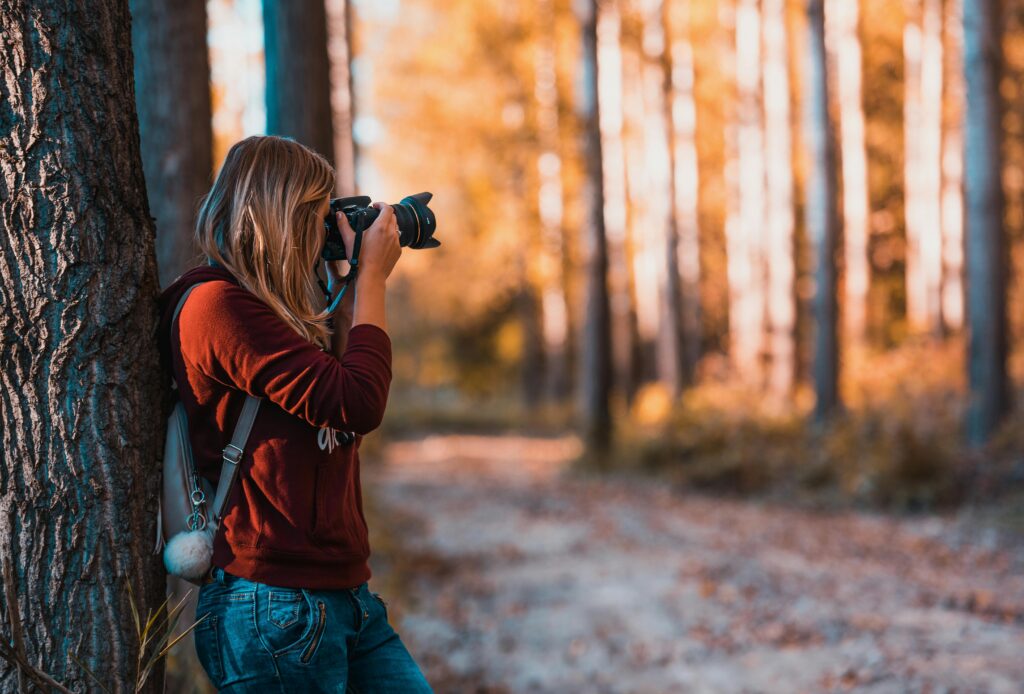
That’s how photos have been made since the first ones. Except for some technical details – and these are quite significant for the experience of the photographer:
- The camera captures the picture much faster now, so you can hold the camera in your hands – mostly, no tripod is needed. And you can even walk while shooting. Shaken photos are rare nowadays!
- Now it’s mostly digital. There are some photographers who like to use films, but almost all photographers use digital cameras for most of their photos.
- Digital photo means automatic adjustment to the light level, for instance, and the possibility to use the photo immediately. You don’t need a darkroom with chemicals an all.
- It is easy to adjust the digital photos afterward. Physical filters on the lens are not needed anymore.
- Cameras are smaller now, with better quality of the photos.
- You need to bring batteries…
- A digital card for storing photos can hold hundreds of them, so photographers today often take many more photos – and then sort them afterward.
Enjoy the result
The one who is looking at your photo, when you are done shooting and editing it, will not find things very different. Of course, most photos are in color now, but not all, so that is hardly a significant change. Black and white photos are still popular.
What they do see as different, though, is the different kind of motives. You’ll still shoot portraits and photos of monuments, buildings, and nature. But you might also make a photo of a person holding a sign – to use on social media, with a text on it. And there are “meta photos”, where you show a computer screen with a photo on it.
Another new construction is the mix of clip arts and other components into a picture. You’ll typically do that through an online service. Canva, Snappa, and similar template-based tools let you quickly design images for social media. With that, you have probably moved away from being a photographer adjusting their photo – and into the realm of graphical design.
No matter how you did it: your audience will see a photo or a graphical work, but they will usually not know the details about your process and tools.
Reveal the details
Many photographers have found a way of being both the creator, showing their art, and a hobbyist writing about it. A typical photo blog will contain a mix of articles:
- Photo walks, with the inspiration explained, the technical details too, and some selected photos to look at
- Purely technical articles, describing how to make good photos in darkness, for instance, or any other skill sharing
- “My equipment” – photographers tend to gather a lot of stuff, including several cameras, lenses, and other things. And they like to tell about it all
- “My life” articles – as this hobby often takes up a lot of space in a photographer’s life, they feel a need to explain who they are through telling about their life journey with photos
- Other inspirational photographers. This is a helpful world where photographers are happy to endorse and display each other’s works
This way, a photography hobby can become broader than “just” walking around with a camera in the hands. It can fill your life.
There used to be many photography magazines in print, but I think this has become a more rare phenomenon. Just like with everything else, the photo world has gone digital, and almost everything is now on the Internet. Hence, you’ll find websites that test new camera models and other equipment, and in general tell about things you can buy.
Go professional
Well, more or less. There are, of course, many people who live as professional photographers. They may be freelancers who make photos for newspapers and magazines, or they may have a more mundane job as school photo photographer, or drone photographer. Meaning, they have a drone with room for a camera, and with this, they can make aerial photos. Useful, for instance, in real estate sales announcements.
But some go the artist-way, and this can happen through a local photo club – or individually, but the club often offers to arrange exhibitions and competitions. All such activities that are needed for an artist to become known.
I have no idea how many photo artists actually live from their art, and this way can be called “professional photo artists”. But I have a feeling that most are not. It is more common to do this as one of several activities – within art, or with some traditional professional activities next to the art.
In general, it looks like photographers like to spread their wings over many ways of making photos, and it is difficult to find any, who never make artistic photos.
Equipment for photography
Photography hasn’t changed fundamentally since its invention, but the practical details are different now. And much easier to deal with.
The basics
The first camera was simply a box with a hole in one side. It had a plate covered with photographic film on the opposite side. When light was allowed to pass through the hole for a moment, it left a negative image on the plate.
When using a modern camera, this is basically still how it works. Now, the camera has a lens, though. This allows for collecting more light and shape it to fit the plate. And the plate itself is now covered with photocells. You can, with this setup, make photos in less light, and you can make them faster.
Also, you can make many photos without changing the plate. A film camera still needs a roll of film, each having space for maybe 24 or 36 pictures, but the sensor plate will last for millions of photos. A digital camera will then save the photos on an SD card or similar. It actually works like a computer, saving the image as a file.
You sometimes have the option of changing the lens. Sometimes it has a zoom mechanism, but it is not uncommon to have a fixed lens that always has the same amplification rate. Most cameras allow for switching between different lenses.
What you have
You have a smartphone! There’s a 99.999% chance that I’m right in that claim, because these have become incredible popular. And they all have one or more built-in cameras. In fact, much of the development toward new models, is about the camera function.
And, in the same way, I can claim that you have a computer. You can put some software on the computer – there’s a lot to choose from – for editing your photos.
This is the most typical equipment for making photos today. There’s even a camera in most computers, so you could possibly do without a smartphone or a dedicated camera.
It means, that everybody can make photos, and basically with what they have.
Photography with a dedicated camera
If you go this way, you’ll get hooked and soon buy a lot of stuff. It can easily become a “buying hobby”, like so many others in the modern world. You’ll probably find that 90% of everything talked about with other photo enthusiasts is about equipment, not the act of photographing.
But you don’t have to do that! It really is your own choice, and you can make great photos with just a small amount of equipment. An older camera might work. One lens. Some kind of protective bag is preferred. And then the SD cards and batteries – enough for a day of joyful photographing.
If the buying bug does bit you, you’ll probably spend more time on looking at your equipment, and less on actually photographing with it. But it can be fun too.
Photography with a smartphone
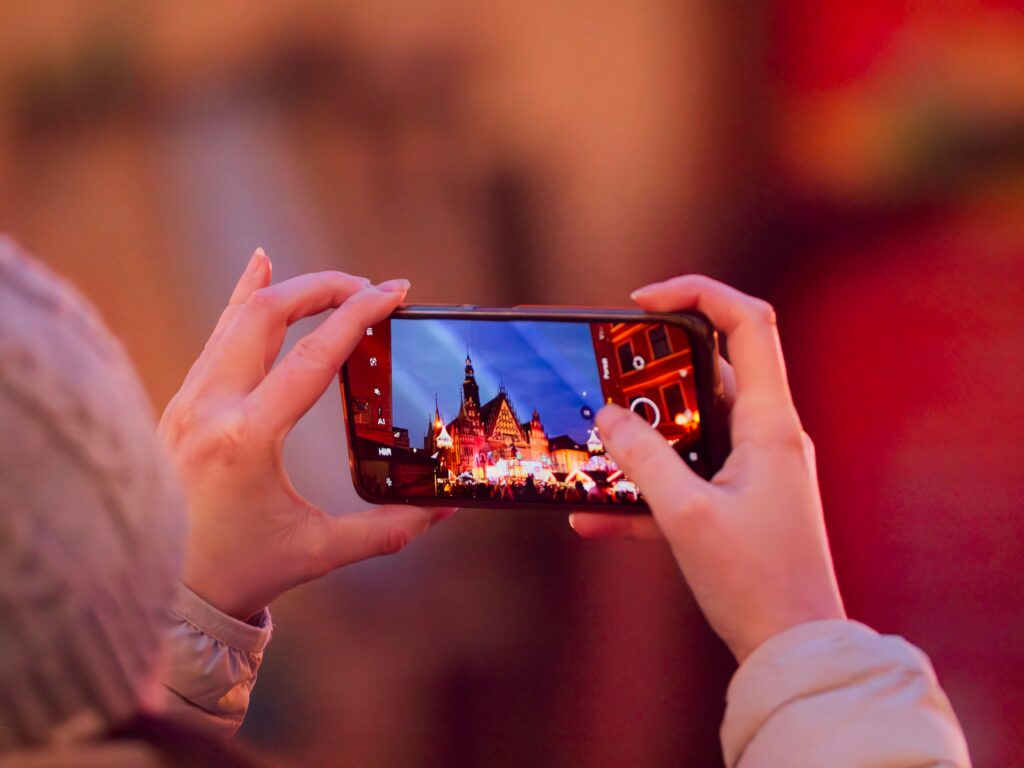
They usually make very good photos. I mean, really! High resolution, good mechanisms (software) built-in, that will correct low light, greasy fingers on the lens, etc.
But the lens is typically very narrow, and that will mean something for the physical options of the camera – what photos it can make, mechanically. Everything else, such as a nice bokeh or a long zoom, is done by software.
This means that you can make great photos, but to 95% only of what you can do with a good dedicated camera. That’s enough for most cases, but probably not for the very dedicated artist.
However, the great advantage is that you almost always have your smartphone at hand, so you can always make photos. Never need to miss a good photo opportunity.
Post-processing with software
Dedicated cameras will mostly be capable of creating so-called “raw” format pictures, plus typically also jpeg pictures and maybe other formats. If you have raw pictures, they require a special raw picture editor for certain adjustments. You can do most of the same things with such software, as you could have done with the camera itself, when taking the photo: adjusting the light level, or the type of light (flouroscent light tubes give very different colors than sunlight, for instance). Or changing the contrast level, or the sensitivity for certain colors.
With a raw editor, you can, hence, do all what you would have done with filters and great skills in the old days of analogue photography.
Other programs are more ordinary image editors, such as Adobe PhotoShop, where you can cut the size as you want it, and add many different special effects.
Most digital photographers use such programs. It is not considered cheating, just be clear! It is simply the previous mechanical preparation that has moved a bit in the total process of creating photos, and now become a post-processing activity.
There are very many different programs to choose from, for the computer, but also for the smartphone.
Where AI comes in
Why are we making AI a topic of everything we write? Can’t we just keep it out and focus on the real topic – in this case, photography?
Almost inavoidable
Actually, AI doesn’t have to come in, and you may not want to use it. Photography can be one of the few pure art forms left, for those who want it to be that. But since many people consume photos without making them themselves, AI is a convenient way to get them.
You’ll find AI everywhere, even when you don’t know it. In the cameras, for instance, you get help from AI to adjust certain details, to make your photos look better. You just have to point and shoot, basically. In the post-processing software, you use AI as part of many features, even if they are called “filters”, or “effects”, or something else, without mentioning AI.
Using AI on purpose
But you can, of course, also “make photos” by asking a generative AI website to make you some. You can turn it into kind of an artform in itself to prompt the machine in such a way, that it produces what you want, and you can then call it “yours”. Legally, it isn’t yours. You don’t have a copyright on AI-generated stuff. But you can use it, and you can tell others that you made it.
When we look at photography as art, we usually mean the kind of photography where you have pointed a camera at something and clicked the trigger. But since you may use post-processing software to give the photos their final touch, you could end up with a mix.
I can’t always tell if an artist made a photo the “old-fashioned” way with a camera, or if they used AI as their tool. But an artist will always try to show something. They will have a reason for making the photo look as it does. Just like a painter, or a sculpturer. When an artist works on that basis, it results in art.
Sometimes, a photographer doesn’t want to make a piece of art but wants the photo to show what the world looks like. In that case, I prefer them to leave AI out of the equation – so that the photo as good as possible does show the real world, not the AI-imagined world.
Photography at All of Life XL
All of the above topics will be covered, probably many times, through articles. As this site is for deep dives into thoughts and knowledge, articles may tend to be to the longer side and present some philosophical ideas as well. So, not just the practical guidelines and product descriptions.
In fact, the aim is to describe the equipment as little as possible and focus on the true value of photography – the photos, and what they show. What they hint to, in regard to emotions, literary references, and other elements that make the photos pieces of art.
And there will be photos. Don’t expect them all to be of Man Ray quality, or the equivalents of the Mona Lisa painting. It’s all about intention and approximation, as art always is. That makes artworks unique pieces of expression. And that’s the true value of photography.
Along the way, some dedicated features for finding and watching the photos will be added, but for now, check back regularly at the front page of the site – to find the link, when there is one.
Featured image by JESHOOTS.com at pexels.com